通常形容孩子長大/離家後,父母突然多出很多時間
我到來的更早,主因是妻小10年前到澳洲!我也是那時開始寫 blog, 一晃10年!!還好這10年。。。除了休閒/運動。。。幾乎都投入研究/教學
時間很多,投入很多! 讓我獲得很多成就感,樂在其中。良性循環!!
2019年5月12日 星期日

2019年5月6日 星期一
Milestones of my career
- Why I chose graduate schools (rather than clinical settings): 1988~1990 (my mid 20s)
- Why NTU (but not the others) to work for my career: 1994~ (early 30s)
- Why stroke as research sample (but not hand injury, SCI): 1994~
- Why research FIRST (but not teaching nor clinical practice): 1994~2018 (early 30s to early 50s)
- Why measurement tools (but not effectiveness of OT) and applied psychometrics as research subjects: 1994~
- Why balance/ADL as research subjects: 1994~
- Why item response theory as core knowledge: 2003 (Professor) ~ (>30 SCI/SSCI indexed papers, May, 2019)
- Why quality of life/utility as research subjects: 2004~ (19 papers, May, 2019) (early 40s)
- Why computerized adaptive testing (CAT): 2008~ (16 papers, May, 2019)
- Why cognitive assessments as research subjects: 2008~ (13 papers, May, 2019)
- Why schizophrenia as subjects for cognitive assessments: 2010~ (13 papers, May, 2019)
- Why social cognition as research subjects: 2015~ (early 50s)
- Why AI as core knowledge for future research: 2018~ (middle 50s/before retirement)
- Why child development as TOP research subjects: 2019~
- Why professional skills/SDM as research subjects: 2018~
- Why moving from research to teaching (including teaching-related research): 2018~
- Back to research! Why?

Major milestones
1. Clinical settings presented numerous challenges for me, including limited re-education opportunities, low chances for promotion, low pay, heavy workloads, and minimal autonomy. These were far beyond my ability to change. Moreover, the idea of becoming a doctor, requiring years of additional study and demanding work, wasn't appealing to me. Therefore, I decided against pursuing a clinical path and entered graduate school in the US. Thanks for my parents' financial support!
2. I had several universities to be selected because very few OTs got PhD then. Although I had to be employed as teaching assistant (but not lecturer or higher position) due to my poor academic performance (no published paper), the NTU is the TRUE research university that has given me a huge lift for developing my research ability.
3. Stroke is the largest sample, which can be investigated, in the field of physical OT. In addition, because of distinct diagnosis, and a variety of issues (physical or psycho-social topics, assessments, intervention, or epidemiology) left to be studied, stroke has given me lots of research topics either in-depth or width.
4. During my participation in our 學系評鑑 in 1994, a well-known scholar stressed the importance of research. In addition, I had to be promoted and needed papers.... The other advantage is that there have been so many good physical OT teachers (e.g., Prof. Hsueh, Huang, and Mao...). Thus, I didn't have to offer the majors courses and take great responsibility on clinical teaching. They have taken tons of teaching and clinical loads from me for DECADES.
5. Assessments are fundamental and critical for clinical reasoning, goal setting, treatment planning, showing outcomes, and predicting prognosis. However, our measures currently used at clinical settings have been many miles away form achieving the above-mentioned clinical purposes. That is, there are a great number of big issues (e.g., validation of the current measures, revision of the current measures, and development of measures) left to be studied. If you are interested in this issue, please go to https://atriptouq.blogspot.com/2014/12/cat.html for further details.
Psychometrics can be defined as a study of assessment quality. Psychometric properties (e.g., reliability, validity, responsiveness) are the heart of a measure. Applied psychometrics deals with how to apply psychometrics to validate, improve, and/or develop measures.
6. ADL and balance are primary outcomes for OT. The measures used in 1990s were descriptive rather than standardized. Even the Barthel index was not commonly used at clinical settings in 90s. Thus, there were plenty of research topics for me. So far, I have written >30 papers published in well-known journals. You may go to my above-mentioned blog for details.
7. Item response theory (or called modern test theory) is an advanced test theory, which is useful for validation, simplification, and development of a measure (particularly CAT). I learned it from scratch with the lift from Prof. Wen-Chung Wang. Such knowledge help me revise some well known measures and develop some our own measures. Most of these results have been published in internationally-known journals. In addition, it also help me write several papers regarding individual-level responsiveness, which is an important issue for both clinicians and researchers to validate and select outcome measures.
8. Quality of life (QOL) or health-related QOL is a primary or secondary outcome of OT. Particularly, disease-specific QOL questionnaires had been developed and widely used for almost every disease. In addition, utility (preference of health) is commonly viewed as a generic index, which is useful for comparing effects of different interventions (even different interventions on different diagnoses) due to its generic/universal characteristics. Both QOL and utility are useful for cost-effectiveness analysis and cost-utility analysis. I'd spent several years collaborating with Prof. Jung-Der Wang on these topics. Particularly, we had developed a Taiwanese version of WHOQOL-BREF, which is the mostly used measure among the measures developed by me.
9. CAT means fast and reliable assessments, which are fascinating for all. However, the knowledge and data needed for CAT are a lot. Thus, developing a CAT takes time, effort, as well as luck! However, almost all my CATs haven't been used by clinicians. Something wrong about the utility of CAT. to be added later...
10. Cognitive assessments are critical for goal setting and treatment planning. However, the current cognitive measures have limited or poor psychometric evidence, which cannot support its utility for clinical practice. For example, the psychometric properties of the LOTCA are not satisfactory. Using the LOTCA might be just a waste of time. In addition, it often takes lengthy time to administer cognitive assessments. For research purposes, researchers have to use psychometrically sound cognitive measures to specify or screen patients' cognitive impairments in order to target/match corresponding cognitive intervention protocols. However, most of the current cognitive measures cannot satisfy such needs. Another critical issue is "cultural dependence." Specifically, the items and content of cognitive assessments are highly affected by culture and language. So, the cognitive measures developed in the other countries may not be used here. Thus, we have to develop our own cognitive measures to achieve our research and clinical purposes.
11. Patients with schizophrenia have various cognitive impairments. In addition, they, large size of sample, can be easily reached/assessed in some major hospitals. Thus, they are very suitable sample for examining psychometric properties of cognitive measures.
12. Social cognition has been shown as a critical mediator between cognitive functions and social functions. Impairment of social cognition can be seen in patients with schizophrenia or ASD. Thus, assessing social cognition is important for clinical management or research of patients with schizophrenia or ASD.
13. AI might solve some problems of CATs. Although CAT can achieve fast and precise assessments, development of CATs takes time and luck. There are still lot of of domains without CATs. For using CATs, clinicians have to learn how to administer, which takes time. In addition, they have to install the CATs' programs into their institutions' system. On the other hand, AI can AUTOMATICALLY and SIMULTANEOUSLY assess patients' several physical, psychological, social, and even cognitive domains (e.g., motor, balance, mobility, emotion, attention, executive function, language, social interaction, communication, empathy) via video analysis WITHOUT clinicians' efforts. The results of AI assessments are digitized so that the afterward analysis, application, and output are very useful for clinicians, researchers, and patients!! The progress of AI is very speedy so that we just need to catch up the contemporary advancements and that we don't need to pay efforts to advance the AI technologies.
14. Current assessments of children's developmental domains can be inefficient. Both children and their parents are generally receptive to video recording. Video recordings can capture a child's development across several domains, such as motor skills, language, cognition, emotion, and social function. These recordings can then be analyzed by AI using data from children with normal and abnormal development. Parents would likely be interested in video recording and receiving results from AI analysis over time. AI has the potential to revolutionize child development assessment by helping us assess progress, analyze data, predict future development or outcomes, and generate reports for parents, clinicians, and researchers. Additionally, the techniques, results, and knowledge gained from this approach could be translated to assessments of age-related decline in the elderly population.
Source: https://encrypted-tbn0.gstatic.com/images?q=tbn%3AANd9GcS4gu9bxwh1qVmhUWzhpJxEMAiiDRmafmksEXgZgxgHRtvWgfKn&usqp=CAU
15. Professional skills and shared-decision making (SDM) are both crucial for delivering high-quality and effective occupational therapy (OT). However, effective methods for improving professional skills and client-centered communication remain largely unexplored. If video recording is implemented in clinical settings, patient-therapist communications can be captured as well. Artificial intelligence (AI) could then be used to analyze the recordings and identify both strengths and weaknesses in professional skills. The information gleaned from these analyses would be invaluable in pinpointing areas for improvement and ultimately enhancing professional skills.
16. With < 10 years until retirement, my research potential naturally becomes more limited. As a result, I find myself spending more time on teaching my graduate students and research assistants. I believe my teaching can strengthen their abilities and prepare them for their future careers. The experience I gained from researching topics like OSCE and professional skills assessment will definitely be helpful in my teaching.
Note: It might be interesting for you to find why my priority shifts from "research first" to "teaching first." Also, my research sample shifts from stroke, to schizophrenia, and then to children. Actually, children have been my research sample and I've written several papers in the filed of children.
17. Back to research! I tried teaching and sharing my knowledge/experience with undergraduate students for several years, but ultimately, it wasn't the right fit for me. So, I'm devoting my time to research again, and I absolutely love it! I can't imagine doing anything else for the rest of my career!
2019年5月5日 星期日
台灣科技人才與世界的距離
「台灣少有人才參與整個端對端的產品設計,也欠缺行銷、營運等層面的思考與經驗。簡單說台灣人才多著重在工程層級的技術優化,而非矽谷式創業家式的全面性思維,這也就是台灣科技創新不足的主因。」
「西式教育卻比較鼓勵學生自己找題目,透過寫讀書報告、做問答、寫小論文等方式建構出不一樣的見解,這兩種教育方式產生截然不同的結果。」
詳:2019-05-04 23:12聯合報 名家縱論 簡立峰
「西式教育卻比較鼓勵學生自己找題目,透過寫讀書報告、做問答、寫小論文等方式建構出不一樣的見解,這兩種教育方式產生截然不同的結果。」
詳:2019-05-04 23:12聯合報 名家縱論 簡立峰
2019年4月25日 星期四
投入研究的想法與信心
我想有此想法者多,但有信心者少
可能原因包含:1. 研究的門檻高,短期不易突破,也難有成就感;2. 好的學習環境/伯樂難覓;3. 本身學習瓶頸等
我覺得 1 & 3 可一併面對,好好瞭解自己的學習習慣/優缺點,好好面對/練習,加上高手切磋!之後自然形成良性循環,突破、成就逐一到來。若再有好的環境,那就更美好!
4~6年努力/發表2~3篇論文(第1作者),絕對必須,才有紮實的功力,就會有信心!
4~6年努力/發表2~3篇論文(第1作者),絕對必須,才有紮實的功力,就會有信心!
就「學習習慣/優缺點」以及「環境」而言,這對於年輕人,無論從事哪一項行業皆一樣重要。若就「臨床」與「研究所」環境比較,我想研究所的師資/環境應比臨床好太多。
Note: 我對研究有信心,已老大不小(30好幾了)。因為我碩博班蠻混的,發表第1篇國外論文就超過31歲了。。但約6年後,就信心滿滿了,因為已有把握成為臺大OT第一位正教授!!
我碩博班蠻混的因素大致有二:1.不知論文發表的價值(沒人跟我講);2. 那時覺得只要有博士學位,就有好工作了!也就是當時的「研究識能」很低落。
我碩博班蠻混的因素大致有二:1.不知論文發表的價值(沒人跟我講);2. 那時覺得只要有博士學位,就有好工作了!也就是當時的「研究識能」很低落。
2019年4月11日 星期四
2019年4月3日 星期三
open window 64/曼陀羅九宮格 vs 8 大 核心研究能力
以下聽說是 大谷翔平 的.... (source: https://www.cmmedia.com.tw/)
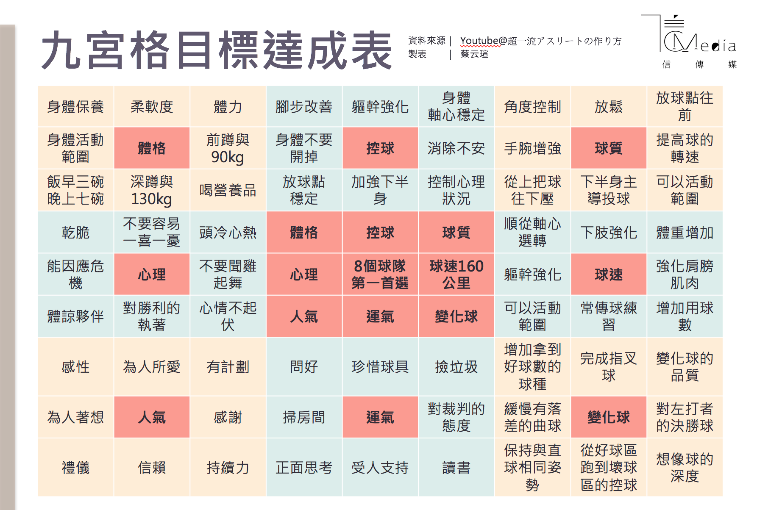
8 大 核心研究能力 跟九宮格一致(下圖為某位博班生的自評能力)

8*8 核心研究能力 進階版(曼陀羅九宮格)April 3, 2019 初設計,
適用於所有研究人員(不論資歷)

歡迎釐清/惠賜意見!
6*6 基礎版--適用於新近研究人員(博班生與博後)

2019年4月1日 星期一
訂閱:
文章 (Atom)